FREHF: A Simple Guide to the Future-Ready Enhanced Human Framework
Technology is becoming smarter every day. It now helps us think, decide, and even feel in better ways. But as machines get more advanced, one big question remains:
How can we make sure technology still puts people first?
That’s where FREHF — the Future-Ready Enhanced Human Framework — comes in.
It’s a new way of designing technology so it understands people’s needs, feelings, and behaviors. FREHF is about humans and machines working together, not competing.
What Is FREHF?
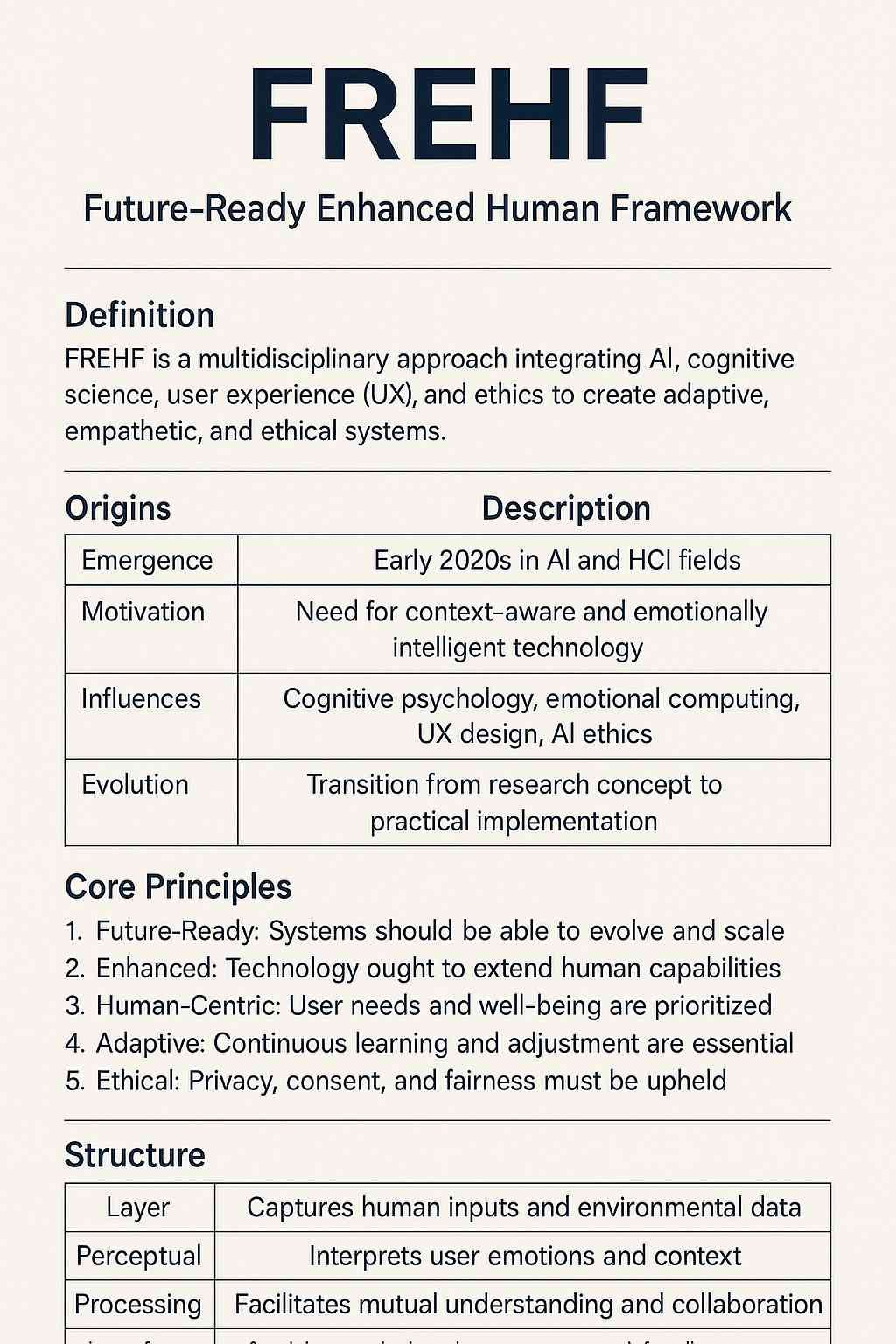
FREHF (Future-Ready Enhanced Human Framework) is an idea that connects people and technology in a smarter, kinder, and more flexible way.
It helps build tools and systems that:
-
Learn from people
-
Adapt to change
-
Respect emotions and privacy
-
Make life easier and more human-friendly
In simple words, FREHF means technology that understands you.
Where FREHF Came From
| Topic | Details |
|---|---|
| When | Around the early 2020s |
| Why | To make technology more caring and human-aware |
| Who | Experts in AI, psychology, and user experience (UX) |
| Goal | To help machines work with people, not just for them |
Older systems focused mainly on speed or power. FREHF adds something new — empathy and understanding. It’s not just about smart computers; it’s about helpful computers.
The 5 Main Ideas Behind FREHF
| Principle | Meaning | Example |
|---|---|---|
| 1. Future-Ready | Able to grow and change with time | A learning app that updates as new knowledge appears |
| 2. Enhanced | Helps people do better, not less | AI that supports doctors, not replaces them |
| 3. Human-Centric | Designed around people’s needs | A website that adjusts for people with poor eyesight |
| 4. Adaptive | Learns from how users behave | A phone that changes brightness based on time of day |
| 5. Ethical | Honest and safe | Systems that clearly ask before using personal data |
These principles guide everything in FREHF — from design to testing.
Read also: Newtopy
Main Parts of FREHF
You can think of FREHF as having different “layers,” like a cake.
Each layer has its own job:
| Layer | What It Does | Tools Used |
|---|---|---|
| 1. Perception Layer | Collects signals (voice, touch, emotion) | Sensors, cameras, microphones |
| 2. Thinking Layer | Understands and analyzes those signals | AI, machine learning |
| 3. Interaction Layer | Talks back to the user | Apps, screens, voice systems |
| 4. Memory Layer | Learns from experience | Data storage, adaptive models |
| 5. Ethics Layer | Protects privacy and fairness | Consent systems, clear policies |
All these layers work together so the system keeps learning and improving.
How FREHF Works
FREHF is based on several key components:
-
Perceptual Modeling – The system “reads” clues from users (like facial expression or voice tone).
-
Adaptive Interfaces – The design changes depending on how the user feels or behaves.
-
Cognitive Partnership – Humans and machines share tasks. The system gives advice, but people stay in control.
-
Emotional Intelligence – The technology can sense and react to emotions kindly.
-
Continuous Learning – FREHF never stops learning. It grows smarter with every interaction.
Real-World Uses of FREHF
FREHF is already finding its place in many fields:
1. Education
-
Apps that notice when a student is confused or bored
-
Lessons that adjust difficulty based on performance
-
Teachers get reports on student engagement
2. Healthcare
-
Chatbots that detect a patient’s stress or worry
-
Systems that remind people to take medicine calmly
-
Virtual doctors that use friendly, empathetic tones
3. Workplaces
-
Software that tracks work stress and suggests breaks
-
Team tools that improve communication and balance
-
Smart dashboards that highlight when someone is overloaded
4. Entertainment
-
Games that change levels based on the player’s emotions
-
Streaming apps that suggest content to fit your mood
5. Smart Homes
-
Lights that dim when you relax
-
Music systems that play calming songs when you’re stressed
-
Rooms that adapt temperature automatically to comfort you
Benefits of FREHF
| Area | What It Improves | Result |
|---|---|---|
| User Experience | Easier and more personal interactions | Happier users |
| Work & Learning | Better focus and less stress | More productivity |
| Business Value | Builds trust with users | Loyal customers |
| Ethical Impact | Respects people’s choices and data | Safer technology |
Extra Benefits:
-
Systems stay useful for a long time
-
Machines can understand feelings better
-
People feel seen, heard, and supported
Challenges of FREHF
While FREHF sounds amazing, it’s not easy to build. Here are some key problems:
1. Privacy
-
Systems may need to collect emotional or biometric data.
-
That means strong privacy rules are essential.
2. Cultural Bias
-
Emotions look different around the world.
-
A smile in one culture might not mean the same elsewhere.
3. Trust
-
Some users might not like technology that “reads” emotions.
-
FREHF must explain clearly how and why data is used.
4. Complex Design
-
Making adaptive systems takes time, money, and skills.
-
It needs teamwork between engineers, designers, and psychologists.
How to Use FREHF in a Project
| Step | Goal | Example Action |
|---|---|---|
| 1. Plan | Identify where human-tech connection can improve | Find moments where users struggle |
| 2. Prototype | Build a small test version | Create an app that reacts to voice tone |
| 3. Ethics Setup | Define clear data rules | Ask users for consent and explain how data is used |
| 4. Test | Check how users feel using it | Collect feedback on comfort and ease |
| 5. Scale Up | Apply across more products | Use the design in other teams or apps |
| 6. Monitor | Keep checking and improving | Update models as user behavior changes |
The Future of FREHF
The next few years will bring exciting changes powered by FREHF.
Here’s what we can expect:
-
Smarter assistants that sense emotion and offer better help
-
Work partners that share creativity with humans
-
Homes and cities that respond to human comfort automatically
-
Global rules to keep technology fair and safe
-
More inclusion — FREHF systems that work for all people, regardless of age or ability
FREHF vs. Traditional Systems
| Feature | Traditional Systems | FREHF Systems |
|---|---|---|
| Focus | Efficiency only | Human emotions and comfort |
| Learning | Pre-set and fixed | Learns and adapts from behavior |
| User Role | Follows system rules | System adapts to user |
| Privacy | Often unclear | Built-in consent and control |
| Goal | Automation | Collaboration |
FREHF moves technology from being a “tool” to being a “partner.”
Key Points to Remember
-
FREHF means Future-Ready Enhanced Human Framework.
-
It’s about machines that learn from and care for humans.
-
The system is adaptive, ethical, and emotion-aware.
-
It works across fields like education, healthcare, and work.
-
FREHF ensures humans stay in control — always.
Conclusion
FREHF is not just a new tech trend — it’s a smarter, kinder way to design the future. It helps make systems that understand not only what we do, but also how we feel. When technology respects emotions, privacy, and purpose, it becomes more than a machine — it becomes a partner in human progress. FREHF shows that the future of technology is not about replacing people. It’s about enhancing humanity — one connection, one emotion, one innovation at a time.